City Living Bus Stops
Sometimes I get an idea about one thing and that makes me leap frog to another related, but also separate idea. I would say that is a little bit of what you are going to get with this weeks blog post.
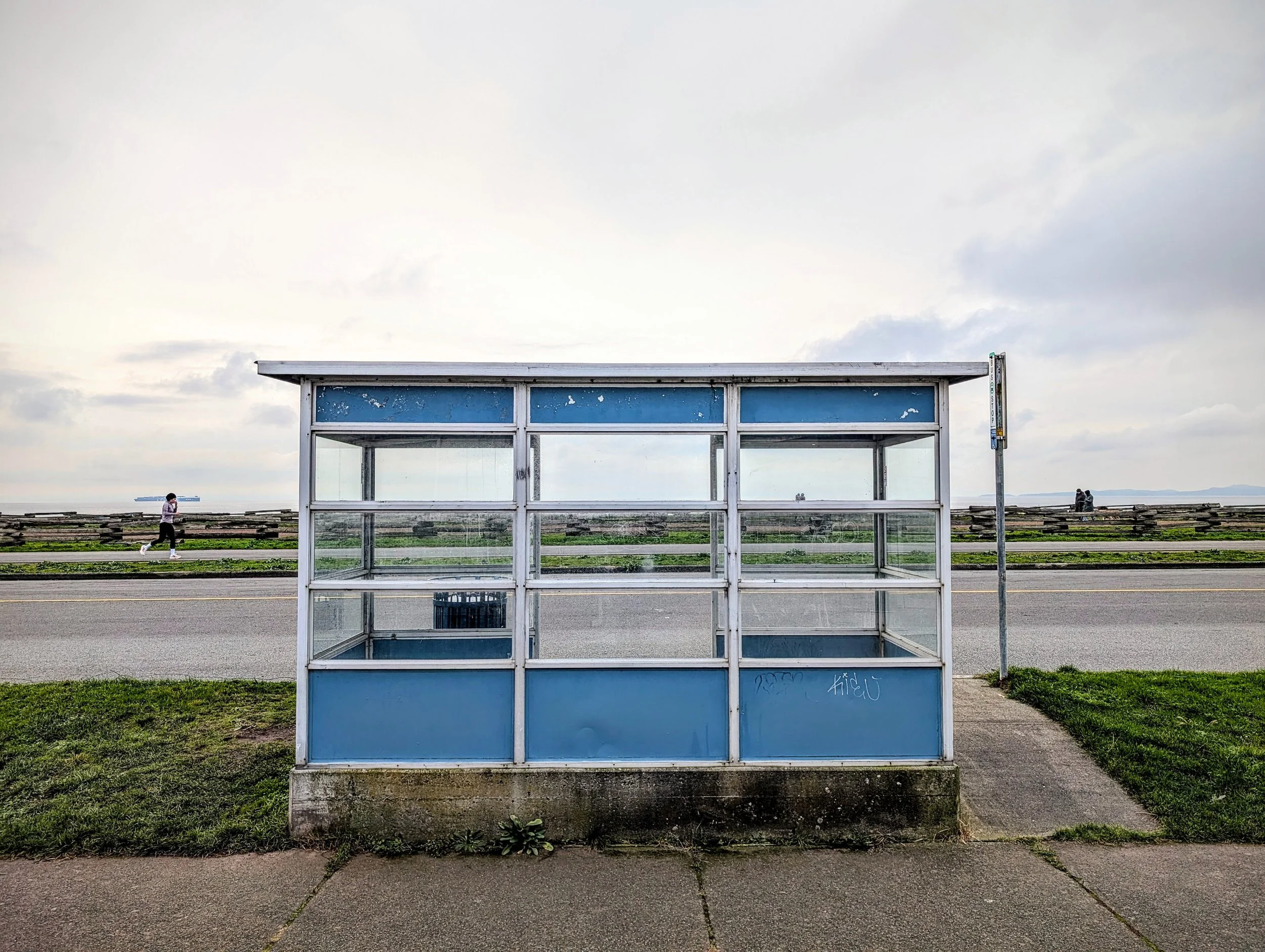
A few weeks ago, the City of Victoria removed the old aluminum bus shelter from the bus stop by my house. I knew in the back of my mind that there was a sort of anachronism in it being my closest bus stop, but I also didn’t think it would disappear. Growing up, this style of an almost fully enclosed shelter was the norm; and it makes sense given the weather we experience in southern BC. In Victoria, when we so often get wind and rain together that enclosure is even more necessary. Since that shelter disappeared, I have been having a couple of conversations about them and it seems there is an active push to remove the last few. That got me thinking about two things really. What is happening to the old shelters that are being removed? And then, in looking at the large public space surrounding the bus stop at Blackwood and Haultain, are we missing an opportunity in creating new public spaces?

Reuse Idea for the Old Bus Stops
From an aesthetic perspective, I love the old bus stops. I have not gone too much into the history of when they were first built, but I assume that they are from the 1970’s, maybe the 1960’s. The strong horizontal and vertical lines give them an almost ‘International Modernist’ look. The best thing about them though, is that they actually protect you from the elements as you wait for the bus. Now, I should be clear, it protects me, however, one of the reasons for removing them is that they do not accommodate all people and specifically those with accessibility challenges. So I do understand the impetus for removal, I just don’t understand why the new shelters couldn't be designed to protect you from rain and wind. Many of the new shelters don’t even have benches and I know that people will raise the issue of the unhoused population in response to almost everything in this article; I personally feel this perspective is overstated and certainly is not an issue in relation to all of these old shelters across the city (including the one at Blackwood and Cook). A bench just makes waiting for the bus more pleasant.
Okay, I am moving away from what I wanted to talk about, so these old shelters are being taken away, but could there be an alternate use for some of them? My thought train immediately went to the woonerf by my home along Kings Road. At Kings and Mt. Stephens, there is the beginnings of a community gathering spot. On one corner is a beautiful natural wood bench that often sees groups of people chatting and kitty corner is one of the many Little Free Libraries found across the city, though this one does seem to get more use than many of those. Could we use these disappearing bus shelters as community gathering spaces around the city? I did a little drawing (sorry!) of how you could arrange the interiors of these shelters. Though, I could also see them being a tool library, or perhaps a community food market where you can take your extra garden veggies. Really the possibilities are endless and the bonus is that we would get to keep a piece of historic infrastructure and reuse it in a positive way. They have lasted at least forty years, I am sure we could double that.
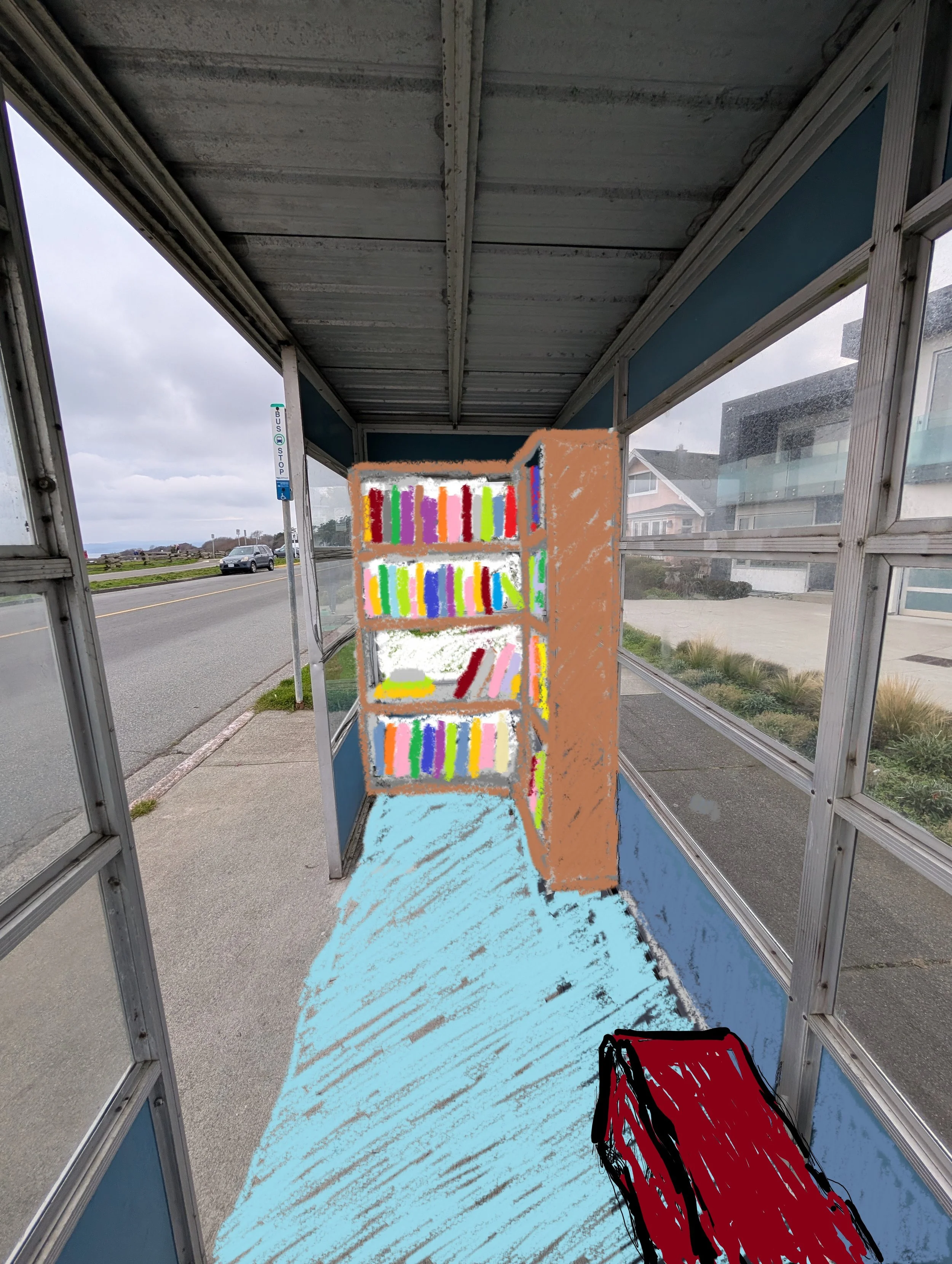
How you could possibly set-up one of the old bus stops as a Little Free Library and reading room.
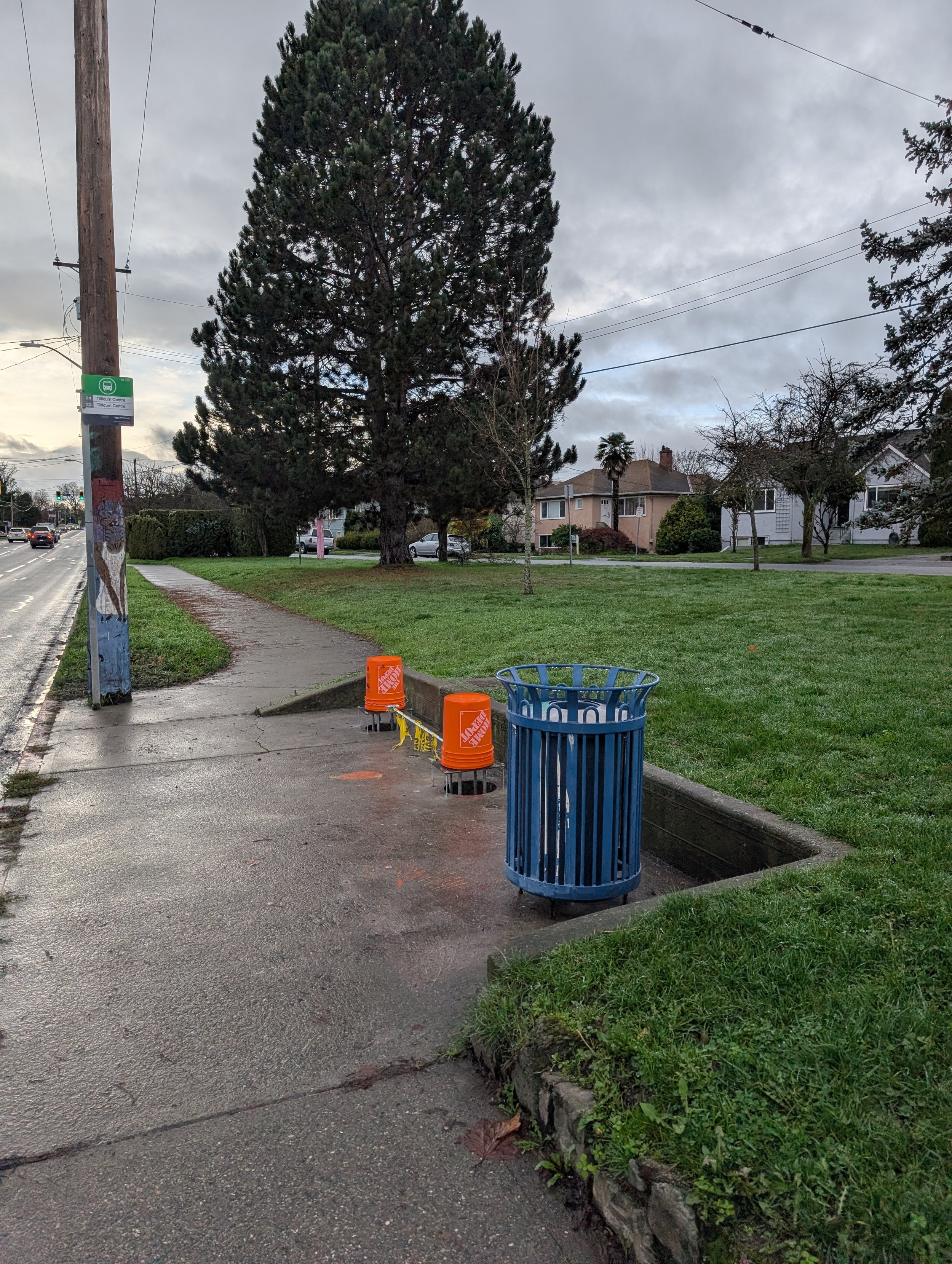
This bus top has now been replaced with one of the boring new ones. But just look at all the space behind it!
City Living Bus Stops
As I said, that one idea made me think about the spaces the bus stops were being removed from. I noticed that quite a few sit on big parcels of unused space. Not a park, but not quite small enough to be a boulevard. I have written about a few of these liminal places before on the blog here. Though in that article I focused on some of the larger parcels that could easily have room for new housing or a park. These smaller green spaces that have a bus stop create real opportunities for community places.
After picturing that space at Kings and Mt. Stephens with the bus shelter there, it made me turn my mind back to where the old shelter at Cook and Blackwood was. As I said, there is a massive amount of space at this bus stop that is just there. This green lawn is not particularly landscaped or made accessible. What if there was a way we could build a proper large and protective bus shelter and perhaps turn the surrounding space into something beneficial for the community? This location may not be the perfect spot yet, as the 24 & 25 routes are still too infrequent. But in the right space this could work from a positive public space perspective. Bus stops are by their very nature, dynamic. They provide a continuous flow of people both waiting for the bus and disembarking from it. Add something like the woonerf space I described above or the gathering space that exists at Queens and Chambers (photo at the end of the article) and this could easily become a focal point for the neighbourhood.
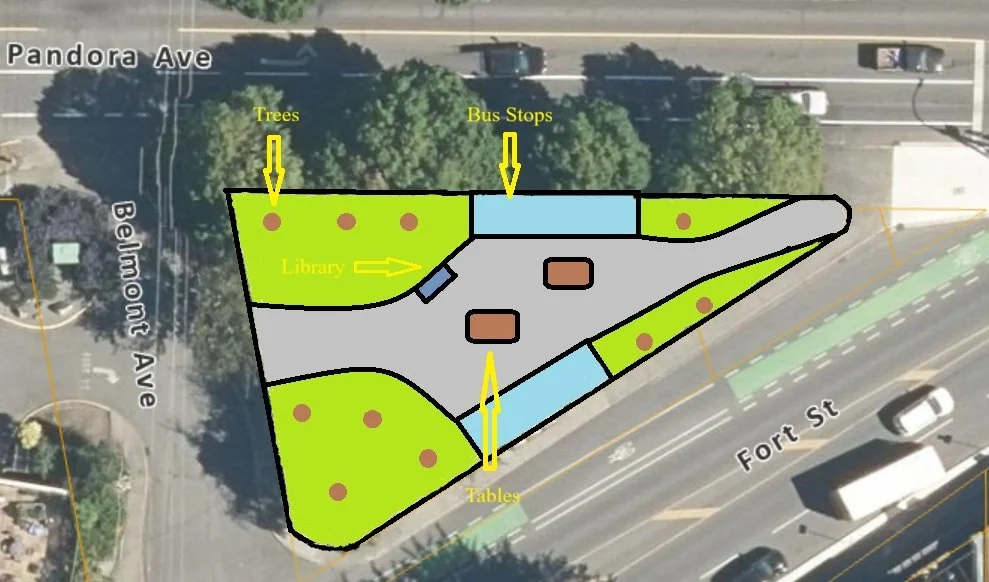
One of the best options for this sort of enhancement around Victoria is at Oak Bay Junction. Here where Pandora and Fort Street diverge, you have another of these odd green spaces and even better than in other locations, two older bus stops, one on each side. Creating a dynamic community space in-between the two stops combined with new shelters with functional weather protection would be fairly straight forward. Easy ideas for these spaces could be the little free libraries as discussed earlier, but could also be coffee or food vending in the right locations, picnic tables, chess boards or bocce courts, even electric grills for cooking. Really the opportunities are endless and done in the right way, could have some amazing results for community and public transit at the same time. I have done another drawing of the space at the Oak Bay junction here. It is pretty basic, but shows how what is now essentially a traffic island could be a transportation icon and a community gathering space at the same time.
I realise that again, the knee-jerk reaction to something like this is that it will be a hotspot for the unhoused or public disorder, but we already have some good examples near by and both of them are positive places in the community. One is actually just a few blocks to the west at another junction point. Where Yates and Fort diverge, the City put in an amazing small public space when the bike lanes were completed in the area. You can read my article about that here. The benches and the small rail installation piece are subtle, but I have stopped here many times and enjoyed the space despite it being right by a gas station and lined on either side by roads. I have often been joined by other people in enjoying the benches, but haven’t seen anything concerning at all. Another wonderful community living room is located on Chambers Street behind George Jay Elementary School (mentioned above and photo below). Here, there are several concrete pieces that are actually essentially a living room outside on the street. While, I will say that if you want to use the space for a long time, cushions are required, still all I have ever seen happen here is people gathering to chat.
Across the city there are many places where there are opportunities to create these ‘city living rooms’ and I think collocating them with bus stops is a wonderful way to bring in further dynamism and vitality. I think another place this could work is Humber Green and we could have had one downtown if the plaza plan had been allowed to proceed at Centennial Square.
I would love know where you think we could co-locate a transit stop with a community gathering space? Or if you have a great idea on how we could re-use one of those old bus shelters somewhere in the city, let us know in the comments.
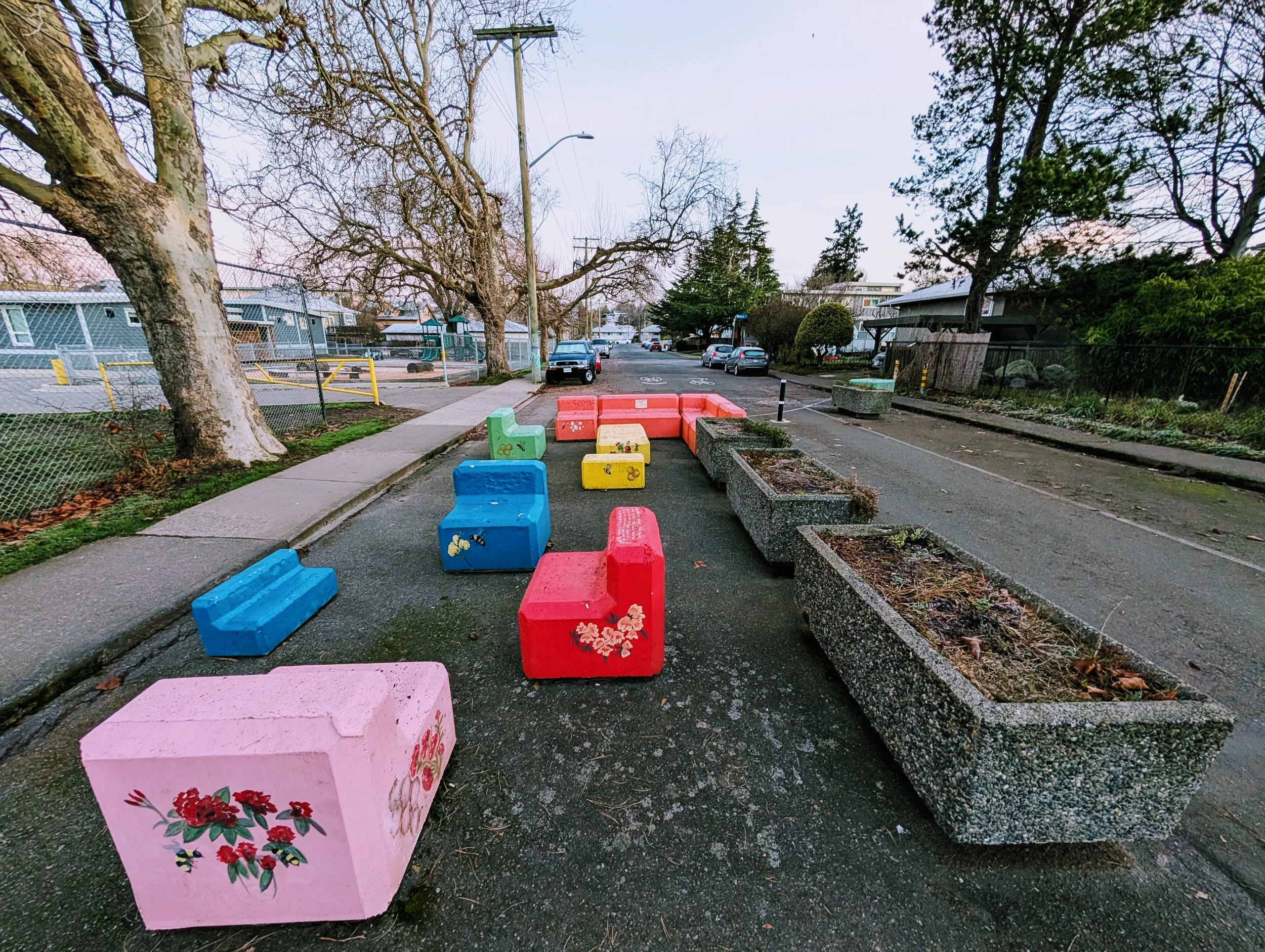
The Queen’s Chambers at Queens and Chambers