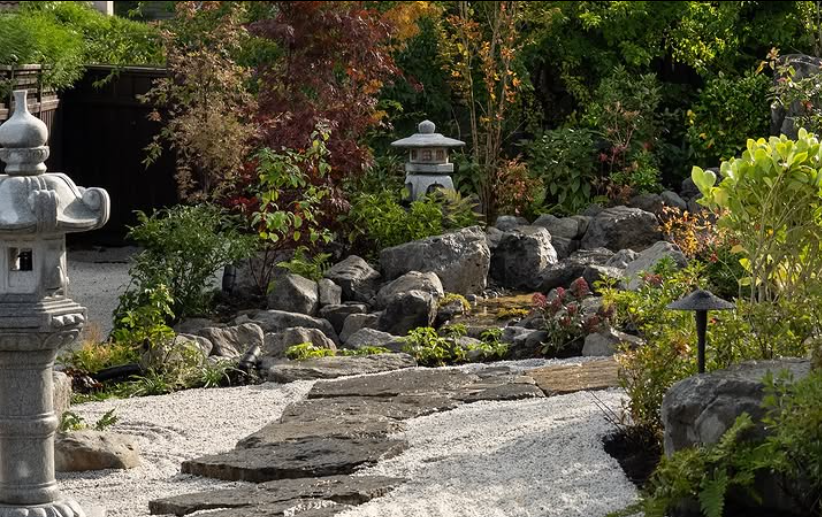
A small garden can change the experience of a city home more than its square footage suggests. In dense neighbourhoods, the outdoor spaces that matter most are often not lawns at all. They are narrow side yards, front setbacks, courtyards, patios, strips between a walkway and a fence, or a view framed by a kitchen window. When these spaces are treated as leftover land, they feel small. When designers compose these spaces deliberately, they can feel like a destination.
That is one reason Zen-influenced garden design has relevance well beyond a particular historical style. At its best, it is not a checklist of lanterns, bamboo, and raked gravel. It is a way of editing space: deciding what deserves attention, what should stay quiet, how movement unfolds, and how a person’s eye travels through a scene. Those are useful questions for almost any compact urban garden.
Start with the View
A common landscaping mistake is to begin by listing objects: a tree here, a planter there, perhaps a bench or water feature in the remaining corner. The result may contain attractive individual pieces while lacking a strong overall composition.
A more spatial approach begins with viewpoints. Where will the garden actually be seen from? The front step, dining table, living room window, and path to the garage may all reveal different versions of the same yard. Designing from those positions turns the garden into a sequence of framed scenes rather than a collection of purchases.
For homeowners looking at examples of how these ideas are interpreted locally, a portfolio focused on Zen garden Vancouver projects can be useful precisely because it shows how stone, planting, paths, screening, and negative space can be combined within real residential constraints.
This is similar to good urban placemaking. A successful plaza or pocket park is rarely memorable because it contains the greatest number of features. It works because its edges, routes, focal points, and places to pause have been considered together. The same principle scales down surprisingly well to a residential garden.
Negative Space is Doing Real Work
In a compact yard, space can feel like something that needs to be filled. Yet visual breathing room is often what makes a small garden feel larger. A patch of gravel, a simple plane of groundcover, an uncluttered wall, or a stretch of moss can create contrast with more detailed planting and stonework.
This is not emptiness for its own sake. The quieter area gives the eye somewhere to rest. It also makes a carefully shaped tree, a textured boulder, or a change in elevation more legible. In design terms, restraint creates hierarchy.
The idea is especially useful in cities because urban gardens already compete with visual noise: fences, neighbouring buildings, utility boxes, parked cars and windows. Adding more objects does not always solve the problem. Sometimes the better move is to simplify the foreground and control what is revealed.
Paths Can Make a Short Distance Feel Meaningful
A path is described as circulation, but it also sets the pace of a garden. A straight route says: get from A to B. A path that shifts slightly around a planting bed, narrows beside a stone, or changes material near a sitting area creates a different rhythm.
That does not mean every small yard needs a theatrical zigzag. Forced complexity can be just as awkward as a featureless rectangle. The useful lesson is that movement deserves design attention. Even two or three deliberate moments—a threshold, a turn, and a place to stop—can give a compact space a beginning, middle, and end.
In an urban setting, this can also improve privacy. A route that does not immediately expose the entire yard can make the space feel more secluded without relying on a solid wall around every edge.
Use Screening to Shape Attention
Privacy is often approached as a height problem: build the tallest allowable fence and block the view. But complete enclosure can make a small garden feel tighter and darker. Layered screening offers another option.
A partially open fence, a narrow tree, a shrub mass, or a change in level can interrupt sightlines without creating a fortress. The goal is not always to erase the city outside. It can be to decide which pieces of the surroundings belong in the garden’s composition and which ones should recede.
Japanese garden traditions have long used borrowed scenery—the incorporation of distant or surrounding landscapes into a designed view. In a contemporary city yard, the “borrowed” element may be a mature street tree, a mountain glimpse, the upper canopy of a neighbour’s maple, or even an interesting wall. Framing what is already there can be more effective than trying to manufacture every part of the scene.
Design for Weather and Time
A garden is not a static rendering. Rain darkens stone. Moss thickens. Leaves change colour and fall. Bare branches expose distinct lines in winter. Morning and evening light land in different places. Good outdoor design anticipates these changes instead of treating them as maintenance problems.
Vancouver’s wet season makes this especially visible. Materials that look one way in summer may become richer and more reflective in the rain. Drainage, footing, and slip resistance matter, but so does the sensory experience of water moving through the site. People may observe the garden more often than they occupy it during colder months, making covered viewpoints from inside the home as important as outdoor seating.
This is where a modest yard can become genuinely rewarding. It does not need to perform as a party space every day of the year. It can also work as a living view—something that changes with weather, season, and light.
The Quiet Garden as a Piece of the City
Cities are full of intensely programmed spaces. Streets move people, cafes sell things, parks host activities, and homes absorb the practical demands of everyday life. A small garden can offer something different: a place where not much needs to happen.
That may sound minor, but the ability to sit, look, listen, and notice is one of the rarest luxuries in dense urban living. Zen-influenced design is valuable not because every homeowner needs an explicitly traditional Japanese garden, but because it reminds us that calm can be designed. Sometimes the most successful small space is the one that knows exactly what to leave out.